My website, including this very page, is still under development; your question may appear in the future. Still, contact me! If you wish to be quoted, anonymously or not, for context, let me know!
JumboSizedFish originated from coming up with a username for my Steam account in September 2020. I wanted a new username that's rememberable, concise, and professional, yet JumboSizedFish was generally done on a whim.
"Jumbo-sized" was inspired by the movie Super Sized Me, but I unfortunately do not remember why I went with jumbo instead of super or any other adjective; it might be because I misremembered the Big Gulp brand as "Jumbo Gulp."
What could I abbreviate "JumboSizdFish" as? (Back)
Jumbo, JumboSF, or JSF. Some people have called me Fish as well.
Are you fine with people translating your pseudonym? (Back)
Yes; what I do ask, however, is to write it also in English where appropriate.
Are you fine with people parodizing your art style? (Back)
Yes, for any purpose. Just don't lie to others that I (and others) made your artwork.
Website
Where should I link your button to on my website? (Back)
Ideally the home page (https://jumbosf.neocities.org/), but you may link it to anywhere reasonable, such as my itch.io, IndieDB, and OpenGameArt pages or my Steam community profile.
May I use the Copyfree and/or BSD + Patent(s) buttons? (Back)
You may!
Views
This section focuses on clarifications and answers to specific positions.
Copyright
While these questions are answered to the best of my ability and without any malice, I am not a lawyer; if I were, I am not yours either.
I am not (yet) associated with or endorsed by the Copyfree Initiative. Comments about copyfree licensing are my own.
The "public domain" is a body of works (such as books, music, movies, inventions, and software) that are not protected by copyright, patent, or trademark law; therefore, anyone can freely use, copy, share, and adapt them without needing prior permission.
A creative work enters the public domain if:
The copyright(s), patent(s), and trademark(s) on it had expired;
The copyright on it was not properly registered, claimed, or renewed;
It was never eligible for copyright, such as not being sufficiently creative; or
Its author intentionally released it to the public domain.
Copyfree is a licensing policy and philosophy about maximizing personal freedom with a creative work. It's in contrast to copyright and copyleft, as it doesn't grant the author exclusive rights over a work nor does it control how others can distribute their adaptions.
It is a specific classification of a permissive or non-copyleft public license:
Free Use: A copyfree license does not place any restrictions on the use of the licensed material, and protects recipients of the material from such restrictions except insofar as explicit individual contractual agreements are concerned.
Free Distribution: A copyfree license does not place any restrictions on the distribution of the licensed material except regarding the license itself, and protects recipients of the material from such restrictions except insofar as explicit individual contractual agreements are concerned.
Free Modification and Derivation: A copyfree license does not place any restrictions on the modification of — and derivation from — the licensed material external to the license itself, and protects recipients of the material from such restrictions except insofar as explicit individual contractual agreements may be concerned.
Free Combination: A copyfree license does not place any restrictions on materials outside of the licensed work itself, nor does it explicitly limit the licensed work in combination with materials external to the licensed work.
Universal Application: A copyfree license does not place any restrictions on who benefits from the terms of the licensed material, except in the event it specifies provisions to revoke its terms for those found to have violated the copyfree protections of the license. The license is also applicable to recipients of the material distributed under its terms without requiring the execution of any additional license by the distributing and receiving parties.
Business Advantage
What most people would probably consider a "traditional" creative business model is embodied in a number of industries dominated by large, centralized, corporate distribution networks, such as major book publishers, MPAA member film studios, and RIAA member record companies. What economists would describe as "artificial scarcity" is created and enforced via copyright laws, and these industries make use of that to generate revenue by selling physical and digital media and prohibiting others from selling them in competition with the copyright-dependent distributors.
These distributors have long been regarded as necessary for commercial success, as superstars such as Metallica and Stephen King would not have reached as wide an audience without national and even international marketing and distribution provided by the industry dominating distributors. The vast majority of creators in such industries saw little of their royalties or other unit sales income, however, and either made a more modest living through more personal interaction with consumers (e.g. touring for bands) or by maintaining a dayjob alongside their creative work. The commercial benefits of widespread distribution mostly applied only to the distributors, leaving many producers of creative works to make what money they could in much the same way that itinerant actors, musicians, puppeteers, and storytellers did centuries ago.
The business landscape is changing, however. The fact that the cost of copying and distributing a digital representation of a work is plummeting to effectively zero undermines the major distributors' business model as many consumers of new works actually find it in some ways more technically difficult to avoid sharing copies of what they possess than to (often unintentionally) violate the restrictions of copyright law. While some complain that this is destroying the profitability of industry business models for creators and distributors, others embrace this as providing the ability to bypass the industry gatekeepers to distribute and market their works essentially for free, enlisting the filesharing fanbase as a replacement for those corporate distributors.
Whether you believe that copyright violation by fans is wrong, the truth is that it is becoming increasingly difficult to halt such informal filesharing, with no end in sight to the increasing ease, frequency, and ubiquity of filesharing. For the independent creator, whose biggest concern is usually obscurity rather than "piracy", the best way to address filesharing is to use it as leverage to reach a wider audience and employ business models that benefit from rampant filesharing rather than depending on the apparently impossible task of stopping it.
Cultural Persistence
The durability of culture is an important concern. There are many film, magnetic, and digital archives of cultural works that are vulnerable to loss due to a combination of copyright restrictions and low perceived commercial value. The extent to which a cultural work is kept to a small, restricted state of archives, it is vulnerable to loss due to digital storage failure, fires and floods, and the occasional negligence of caretakers, among other problems. Indeed, even the cost of maintaining an archive can induce a caretaker — often the copyright holder, when a work is not considered currently commercially viable — to intentionally delete or destroy archives of cultural works.
Simple acts like sharing freely downloadable digital archives over the Internet, with no notable restrictions on copying and redistributing in any form, can significantly mitigate the danger of loss for many cultural works. In fact, it puts most of the cost of (potentially endless) archive duplication in the hands of people who simply want a copy of works in the archive, who will gladly pay the tiny costs involved.
Allowing cultural works to decay and disappear does a disservice to the general public, to historians, to creative people who might draw inspiration from those works, and to the legacies and sometimes even livelihoods of the people who contributed to the creations of those works in the first place. Authors of cultural works can see entire legacies vanish forever if, as is the case in most copyright-heavy industries, the copyrights of their works end up in the hands of corporate distributors whose only interest in the works is their short-term commercial viability; it is ironically, in the face of distributors' arguments based on the supposed needs of artists and authors, a fact that artists and authors are harmed by perpetual enforcement of strict copyright terms for their works when archives of those works are allowed to perish, taking the artists' and authors' legacies to the grave with them.
A piece of software is free and open-source if users have the rights (typically granted from a public license) to use, study, modify, and distribute it and its source code for any purpose.
Its license shall not restrict anyone from giving away or selling it as a component of an aggregate software distribution containing programs from several different sources, nor require a royalty or fee for such sale;
Its source code must be publicly available and reasonably obtainable, and its license must allow distribution of the program in source and compiled form;
Its license must allow modifications and derived works, and for them to be distributed under the same terms of the original software;
Its license must explicitly permit distribution of software built from modified source code, but it may restrict distribution of modified source code, provided that it allows the distribution of "patch files" with the source code that modifies the program at build time; and it may require derived works to carry a different name or version number to differentiate it from the original software;
Its license must not discriminate against any person or group;
Its license must not discriminate on the basis of endeavor;
Its license must apply to all recipients of the program without the need to execute additional terms set by redistributors;
Its license must not depend on the program being part of a particular software distribution;
Its license must not place restrictions on other software distributed along with the licensed software; and
No provisions of its license may be predicated on any individual technology or style of interface.
Given that both the free software and the open-source software movements have some philosophical differences, a program can be either free or open-source.
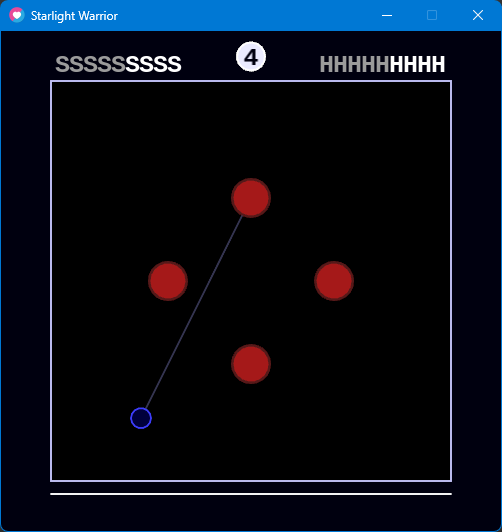
At the beginning of Rifle Warrior's production on November 2024, I wanted to focus on the engine first before settling on a theme. Inspired by arcade shooters and the very basic graphics, I decided on a sci-fi space theme and the placeholder title "Starlight Warrior."
Starlight Warrior had a completely different story that can be roughly explained by its intro: after the unsuccesful conquest of planet Huitis by the Loyalists' supreme parliament, a Confederate president instead sought to conquer the planet with diplomacy; afriad of losing trade potential, Queen Marshall sent out two pilots on a mission to stop the Confederates from seizing Huitis. For reasons I don't remember, I changed my mind and went for a grounded fantasy rural theme. Because Starlight Warrior doesn't make sense anymore, I lazily renamed it to "Rifle Warrior" and it stuck.
Through the span of countless decades, humanity had reached a critical milestone in space technology that allowed men to spread their genes and bear their might across the Milky Way.
Production skyrocketed, improving the quality of life of those home at Earth: filling meals, competitive energy, reliable care, wiser computing... and never-ending conflict.
With the twenty-first century ending with waves of galaxial democratization, an ongoing war between the Loyalists and the Confederates continues to shed blood in the night skies.
February 2108
The coalition embarrassed the Central Parliament with Procedure C26: the Prime Minster's ignorant conquer of Huitis that promptly ended in failure.
Bold for the Civic Democrats, President Charlies instead sought the diplomacy of Huitis' Governor for its untapped trade potential.
Marshall the Second, troubled, sent out two experienced pilots, entrusted with her agenda to restore order in the planet.
Likely sometime in 2026 or 2027. My life has gotten busier ever since I started work on Rifle Warrior, and I admittedly have been procrastinating recently.
What platforms would Rifle Warrior support? (Back)
Microsoft Windows 10/11 and Linux. While not officially supported, I have interest still testing Rifle Warrior (as a .love archive) on MacOS, BSD, and Haiku.
Given that Rifle Warrior runs on the Love2D framework and is open-source, with enough elbow grease, you could run Rifle Warrior on different platforms or older versions of Love2D.
What platforms are you testing Rifle Warrior on? (Back)
My current desktop PC with Fedora Cinnamon and Windows 11;
My old gaming laptop with Windows 11 and Fedora Cinnamon;
My Steam Deck OLED, which uses SteamOS; and
A Haiku VM on my desktop PC.
If you're curious, development started on my laptop, but I (as of June 2026) recently switched to my now current PC.
Where would it, its source, and its assets be available? (Back)
What is the production scope of Rifle Warrior? (Back)
Given that it is generally my first major project that uses the Love2D framework, I wanted to keep the scope of Rifle Warrior and its engine more modest, so planned features such as replays and localization were cut to reduce complexity. I do have plans to eventually remake Rifle Warrior in a more capable and rich engine as a hybrid sequel.
Would you do a sequel next or in the future? (Back)
Mostly: only binaries, source code, and code examples in documentation are copyrighted.
For clarity, the following aspects of Rifle Warrior are in the public domain:
Software and website documentation excluding code examples.
Original assets (including text, sprites, and sounds) and characters.
The rights to publicly display, adapt, and create derivative works of Rifle Warrior.
And the following aspects are copyrighted and not in the public domain:
Binaries, or complied executables, and source code.
Code examples in software and website documentation.
Licensed third-party libraries used in Rifle Warrior.
Rifle Warrior is not a fully public domain work and not public domain software. While I do appreciate promoting Rifle Warrior in public domain communities, please be transparent about its status!
Hell no, and I won't ever have one for multiple reasons.
Do you have plans for an official wiki, and if so, where? (Back)
Yes, but only after Rifle Warrior's release, given that information about it is still subject to change. I haven't decided if it's strictly for the Wilton Brothers (Rifle Warrior) universe or not, among other details.
Because I feel like "Wilton" and "K. Dunn" are slightly more memorable and distinct than "Grace" and "Mary," respectively.
Does Rifle Warrior have any political and/or religious themes and messages? (Back)
While there were undoubtedly countless design choices that were motivated by my views, political advocacy was never a goal for Rifle Warrior; my primary objective was and always has been to deliver an enjoyable and hopefully memorable video game and to introduce a cast of original public domain characters. The story is admittedly an afterthought and only exists to lazily explain why Wilton is on an adventure, but you can still draw your own conclusions what Rifle Warrior "says" and what Wilton, the Showrunner, the Monday Saints, West Bascrook, etc. represent.
Are any of the characters canonically LGBT? (Back)
I noticed that on the itch.io page, Scratch is listed as a used tool. (Back)
Scratch 3.0 (with Scratch Addons, Inkscape, Notepad++, and paint.net) was only used to illustrate some vector graphics, because at the time I started work on Rifle Warrior, I was very new to Inkscape and was more comfortable working with Scratch's costume editor. Rifle Warrior uses the Love2D framework instead.
I noticed that on the itch.io page, it lists BSD 2-Clause, not BSD 2-Clause + Patent. (Back)
itch.io currently does not list BSD 2-Clause + Patent as a selectable license. Maybe some day...